Week 9: Space and Art (Black Holes)
This week's topic was one that I very closely connected with given my passion for astrophysics. I enjoyed learning about the history of outer space beginning from the Copernican heliocentric model and moving onto the realm of space exploration (Vesna, 2023). One of the most interesting topics in outer space which has mostly been an artistic rendering is that of the black hole.
The history of black holes is a fascinating journey that spans centuries of scientific exploration and discovery. It began with the groundbreaking work of the great physicist and mathematician, Sir Isaac Newton, who laid the foundation for understanding gravity in the 17th century. However, it wasn't until the early 20th century that the concept of black holes started to take shape. Albert Einstein's theory of general relativity, published in 1915, provided the framework for understanding the extreme gravitational forces that could lead to the formation of black holes (Crothers, 2006).
In more recent times, scientists like Stephen Hawking and Kip Thorne have made groundbreaking discoveries in black hole physics and astrophysics. Hawking's work on black hole radiation, known as Hawking radiation, revolutionized our understanding of black hole thermodynamics. Thorne's research focused on gravitational waves and the nature of black hole mergers, leading to the historic detection of gravitational waves by the LIGO experiment in 2015. The detection of these gravitational waves confirmed Einstein's prediction made around 100 years ago and revolutionized our understanding of how black holes interact and how the space-time continuum works (Smith, 2016).
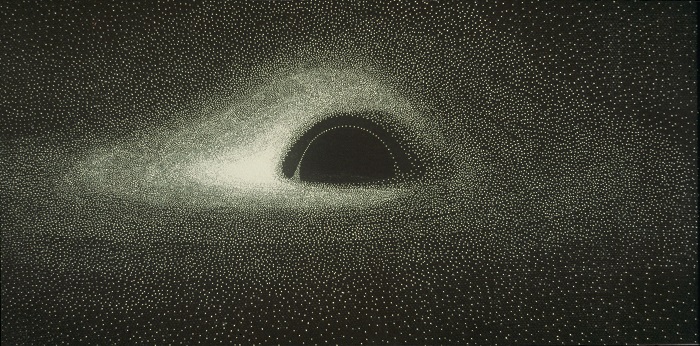 |
| The simulation of a black hole published in 1979 (Source: Jean-Pierre Luminet/CNRS Phototheque) |
What I found most fascinating about these scientific discoveries is how they influenced black holes in movies, specifically the film Interstellar. As shown in the image above, before the theory of gravitational waves and several other properties were known, a then-young researcher Jean-Pierre Luminet used simulation to visualize the first ever accurate depiction of a black hole in 1979 (CNRS, 2019). The director of Interstellar, Christopher Nolan, hired theoretical physicist Kip Thorne to produce a cinematic masterpiece. Nolan and his team created the most accurate depiction of the black hole Gargantua and the video below shows the fascinating detail of this incredible intersection between outer space and the art of filmmaking. The movie was released in 2014 and Thorne stated that "This is the first time the depiction began with Einstein's general relativity equations" (Woodward, 2019).
 |
| This image highlights and explains various aspects of the black hole visualization. (Source: NASA) |
To conclude this blog, I wanted to include some visualizations I made myself during high school to better understand astrophysics and the life cycle of a low-mass and high-mass star. I have included these diagrams below and I think they strongly highlight the overarching theme of this class: art and science are interconnected in ways that can stretch from both the nano-scale to billions of light years.
 |
| Life cycle of a High Mass Star (Source: Utkarsh Kumar) |
 |
| Life Cycle of a Low Mass Star (Source: Utkarsh Kumar) |
References:
Crothers, Stephen J. "A brief history of black holes." Progress in Physics 2 (2006): 54.
Smith, Edwin. "Gravitational Waves Detected 100 Years After Einstein's Prediction." (2016).
“First Ever Image of a Black Hole: A CNRS Researcher Had Simulated It as Early as 1979.” CNRS, 10 Apr. 2019, www.cnrs.fr/en/first-ever-image-black-hole-cnrs-researcher-had-simulated-it-early-1979.
Woodward, Aylin. “The Movie ‘Interstellar’ Came out Exactly 5 Years Ago. Since Then, New Discoveries Have Changed Our Understanding of Black Holes.” Business Insider, 9 Nov. 2019, www.businessinsider.com/interstellar-anniversary-learned-about-black-holes-2019-11.
Reddy, Francis. "NASA Visualization Shows a Black Hole’s Warped World." NASA’s Goddard Space Flight Center, Greenbelt, Md. Available online: https://www. nasa. gov/feature/goddard/2019/nasa-visualization-shows-a-black-hole-s-warped-world (accessed on 24 April 2021) (2019).
Media References:
- Jean-Pierre Luminet, “Image of a Spherical Black Hole with Thin Accretion Disk,” Astronomy and Astrophysics 75 (1979): 228–35
Nolan, Christopher, director. Interstellar 4K HDR IMAX | Into The Black Hole - Gargantua 1/2. YouTube, Apex Clips, 17 Mar. 2021, https://www.youtube.com/watch?v=OA3Txp94pjs. Accessed 1 June 2023.
- Reddy, Francis. "NASA Visualization Shows a Black Hole’s Warped World." NASA’s Goddard Space Flight Center, Greenbelt, Md. Available online: https://www. nasa. gov/feature/goddard/2019/nasa-visualization-shows-a-black-hole-s-warped-world (accessed on 24 April 2021) (2019).
- Kumar, Utkarsh. Life Cycle of a High Mass Star. 4 February. 2019.
- Kumar, Utkarsh. Life Cycle of a Low Mass Star. 4 February. 2019.


Hi! I really enjoyed your blog I thought it was very informational and interesting to read. I also feel very connected to this week's topic so it was nice to see you discuss how this is one of you passions. Very cool blog!
ReplyDeleteHi Utkarsh, I found your blog really informative and highlighted the fascinating connection between scientific discoveries and their influence on black holes in movies, specifically the film Interstellar. The inclusion of specific details, such as the work of researcher Jean-Pierre Luminet and the collaboration between director Christopher Nolan and theoretical physicist Kip Thorne, adds depth to the discussion. It's great to see how scientific accuracy and artistic vision intersected in creating a cinematic masterpiece. Well done!
ReplyDeleteHi Utkarsh, I really enjoyed your work on the development of black hole research, from its roots in Newton's work to the revolutionary contributions of Einstein, Hawking, and Thorne. What particularly stood out to me was the correlation you outlined between these scientific advancements and their representations in film, specifically in Interstellar. This intriguing crossover between scientific discovery and cinematic representation certainly sheds light on the strong relationship between science and art. Lastly, your personal high school visualizations underscore this theme beautifully, demonstrating that the convergence of art and science can be scaled from the microscopic to cosmic.
ReplyDeleteHi Utkarsh, great blog post! Your passion for astrophysics really shined through in this post, and I especially love how you included a bit about Interstellar. I think that sometimes it's easy to forget that movies count as pieces of art, especially when the schema of art is usually a painting or a sculpture. I think that Interstellar did a fantastic job of displaying outer space in such a cinematic way, and I am excited for more pieces of art in the future that are at the intersection of cinema and space!
ReplyDelete