Week 8: Nanotechnology and Art
This week's lecture gave a powerful deep-dive into the timeline of nanotechnological developments and their various applications ranging from materials science to medical technologies, and food/agriculture. The lectures were hosted by Dr. Gimzewski who pioneered research on mechanical and electrical contacts with single atoms and molecules using scanning tunneling microscopy (STM) and was one of the first persons to image molecules with STM (Gimzewski 1998).
The first nanotechnology artwork that truly fascinated me originates from the fourth century AD. Throughout my undergraduate physics and chemistry lectures, my understanding was that nanotechnology is an emerging field and not much was known until the paradigm shifts provided by scientists such as Richard Feynman. The Lycurgus cup from the British Museum collection shows that despite scientific advancements, nanoparticles and structures were in usage and this represents an example of a Dichroic glass (Daw). The dichroic glass changes color once light passes through it and the phenomenon of dichroism was explained in 1990 upon using a STM (Bayda et al.).
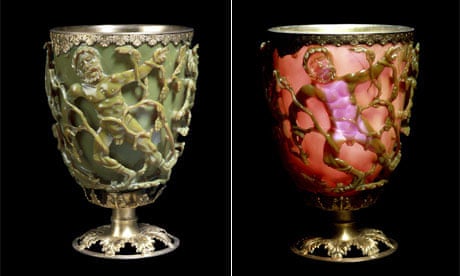 |
| The Lycurgus cup: The glass appears green in reflected light and red-purple in transmitted light. (Source: Daw) |
 |
| The Nanomandala by Professor Vesna |
Bayda, Samer, et al. "The history of nanoscience and nanotechnology: from chemical–physical applications to nanomedicine." Molecules 25.1 (2019): 112.
Daw, Rosamund. “Nanotechnology Is Ancient History.” The Guardian, 24 Apr. 2012, www.theguardian.com/nanotechnology-world/nanotechnology-is-ancient-history.
Healey, Nic. “A Boy and His Atom: A Film Made with Individual Atoms.” CNET, 1 May 2013, www.cnet.com/culture/a-boy-and-his-atom-a-film-made-with-individual-atoms/.
“Nanomandala.” NANO, nano.arts.ucla.edu/mandala/mandala.php. Accessed 24 May 2023.
Daw, Rosamund. “Nanotechnology Is Ancient History.” The Guardian, 24 Apr. 2012, www.theguardian.com/nanotechnology-world/nanotechnology-is-ancient-history.
“A Boy and His Atom: The World’s Smallest Movie.” YouTube, 30 Apr. 2013, www.youtube.com/watch?v=oSCX78-8-q0.
“Nanomandala.” NANO, nano.arts.ucla.edu/mandala/mandala.php. Accessed 24 May 2023.


Hello Utkarsh! Your blog was very fun to read due to the examples of the artwork you chose to discuss about and how they represent the intersections of science, technology, and art immensely well. I was really interested by the Lycurgus Cups you mentioned and how nanoscience was being utilized in the AD times despite my own knowledge of it being an emerging science as well. To see that humans were exploring the concepts and possibility of nanotechnology before its name is fascinating and I'm now very intrigued to learn more about how nanotechnology has changed since the paradigm shift and what other examples exist out there of humans exploring its ideas before Feynmann. Overall, great job on your blog and thanks for sharing!
ReplyDeleteHi Utkarsh, I really liked your post! The way you explore the timeline of nanotechnological developments and their applications is fascinating. It's amazing to see how nanotechnology has evolved over time, from the ancient Lycurgus cup to the modern marvels like IBM's "A Boy and his Atom" film. The Nanomandala installation also showcases the fusion of art, science, and technology in a really unique way. Nanotechnology is such a interesting subject to me, since it allows us to manipulate the basic building blocks of art, and your post did a great job of showing that, well done!
ReplyDelete