Week 7: Neuroscience and Art
This week's discussion was very powerful as it incorporated concepts from both medical technologies and biology that link to create the fascinating connection between neuroscience and art. Neuroscience has always been a fascinating concept for me as an electrical engineer especially when I have had the opportunity to interact with electroencephalogram (EEG) signals and machinery. I wanted to focus on the three artists whose works underlined the connection between neuroscience and art best.
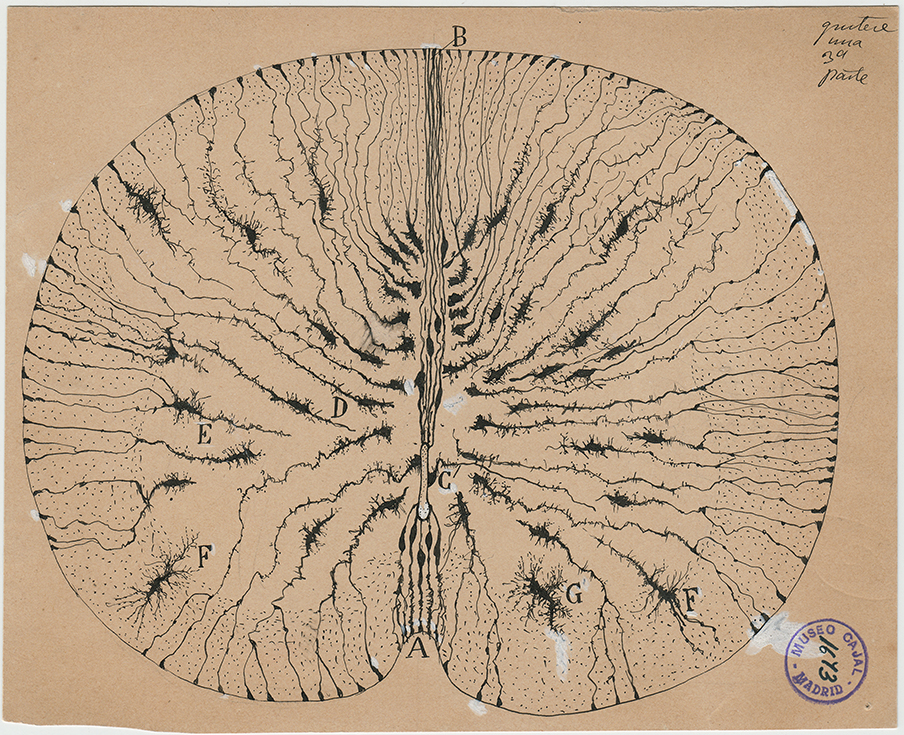 | |
THE BEAUTIFUL BRAIN: THE DRAWINGS OF SANTIAGO RAMÓN Y CAJAL |
Sigmund Freud, a pioneering figure in the field of psychoanalysis, made significant contributions to both neuroscience and art through his exploration of the human mind and its manifestations. Freud's revolutionary theories on the unconscious mind and the interpretation of dreams opened up new avenues for understanding human behavior and the creative process (Lesso). One notable example of Freud's exploration of art is his analysis of Leonardo da Vinci's painting, "The Virgin and Child with Saint Anne." In his book, "Leonardo da Vinci and a Memory of his Childhood" Freud delves into the symbolism and hidden meanings in the painting, employing psychoanalytic principles to unravel the unconscious motives behind da Vinci's artistic choices. Freud analyzed it "as da Vinci’s repressed homosexual desire, triggered by his faint memory of suckling at his mother’s breast" (Harris). Through this analysis, Freud demonstrated the intricate interplay between art, the unconscious mind, and psychological insights, shedding light on the profound impact of psychoanalysis on our understanding of art and human creativity.
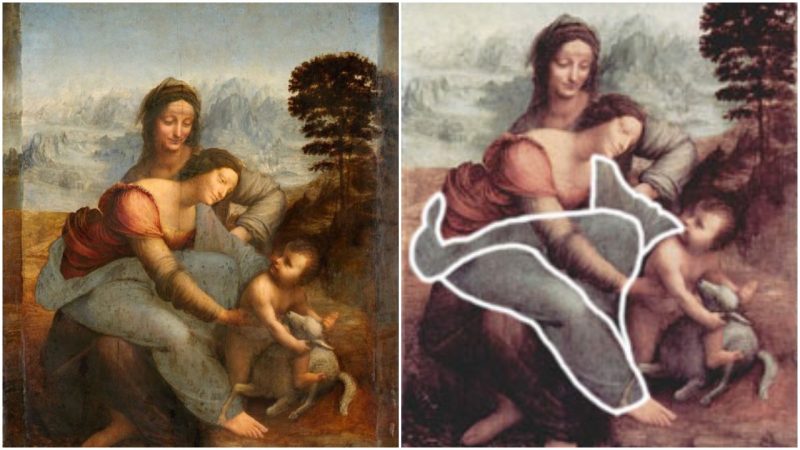 |
| Left: Leonardo da Vinci – Virgin and Child with St Anne Right: The “vulture” identified by Freud |
Brainbow, a groundbreaking technique in neuroscience, has inspired artists to create exemplary pieces that illuminate the intricate beauty of the brain's neural circuitry. Developed by Jeff W. Lichtman and Joshua R. Sanes, Brainbow utilizes genetic engineering to label individual neurons with fluorescent proteins of different colors, resulting in a visually stunning array of hues that represent the complex connections within the brain (Weismann and Pan). Building upon this scientific innovation, artists like Greg Dunn have taken the concept of Brainbow to create captivating and awe-inspiring works of art. Dunn, a neuroscientist-turned-artist, merges scientific accuracy with artistic expression in his creations. Using gold leaf and ink, he meticulously depicts the branching networks of neurons in vibrant colors, capturing the mesmerizing complexity and elegance of the brain's architecture. Through his art, Dunn not only celebrates the marvels of neuroscience but also invites viewers to contemplate the profound mysteries and interconnectedness of the human mind. His pieces serve as a testament to the symbiotic relationship between science and art, offering glimpses into the astonishing beauty hidden within the neural tapestry of our brains.
 |
| Self-Reflected - Microetched print on aluminized polymer by Greg Dunn |
References:
Harris, Larissa. “Freud Analyzed Da Vinci’s Subconscious through His Painting ‘The Virgin & Child with Saint Anne.’” The Vintage News, 30 Sept. 2019, www.thevintagenews.com/2018/07/03/da-vincis-subconscious/?chrome=1.
Lesso, Rosie. “The Impact of Sigmund Freud’s Theories on Art.” TheCollector, 26 May 2020, www.thecollector.com/sigmund-freud-theories/.
Santiago Ramón y Cajal – Biographical. NobelPrize.org. Nobel Prize Outreach AB 2023. Wed. 17 May 2023. https://www.nobelprize.org/prizes/medicine/1906/cajal/biographical/>https://ackland.org/exhibition/beautiful-brain-drawings-santiago-ramon-y-cajal/.
Vesna, Victoria. “Lectures” Neuroscience+Art | Lectures. https://bruinlearn.ucla.edu/courses/160989/pages/unit-7-view?module_item_id=5946342.
Weissman, Tamily A., and Y. Albert Pan. "Brainbow: new resources and emerging biological applications for multicolor genetic labeling and analysis." Genetics 199.2 (2015): 293-306.
Image References:
“The Beautiful Brain: The Drawings of Santiago Ramón y Cajal.” Ackland Art Museum, 23 Apr. 2020, ackland.org/exhibition/beautiful-brain-drawings-santiago-ramon-y-cajal/.
Harris, Larissa. “Freud Analyzed Da Vinci’s Subconscious through His Painting ‘The Virgin & Child with Saint Anne.’” The Vintage News, 30 Sept. 2019, www.thevintagenews.com/2018/07/03/da-vincis-subconscious/?chrome=1.
Dunn, Greg. “Self Reflected Microetching.” Greg Dunn Neuro Art, 10 Nov. 2020, www.gregadunn.com/microetchings/self-reflected-microetching/.


Hi!
ReplyDeleteI really liked your blog and the images you included. It is incredible how these two seemingly different fields can come together to give us a deeper understanding of the human mind. Santiago Ramón y Cajal's detailed drawings of neurons and neural networks were mind-blowing! Also, the concept behind Brainbow is mind-blowing in itself. All of the colors are so cool. You did a fantastic job of highlighting these artists and their contributions. Great work!
I thoroughly enjoyed reading your text! You provided a comprehensive overview of the profound connection between neuroscience and art, highlighting key figures like Santiago Ramón y Cajal, Greg Dunn, and Sigmund Freud. Your explanation of Cajal's meticulous drawings, Freud's analysis of da Vinci's painting, and the awe-inspiring Brainbow technique truly captured the essence of how art and neuroscience intersect. Your text beautifully emphasizes the symbiotic relationship between these disciplines, showcasing how they enhance our understanding of the human mind and invite us to appreciate its intricacies. Well done!
ReplyDelete