Week 6: BioTech and Art
Last week, I gained exposure to the intersection of medical technologies and art and how the evolution of our understanding of human anatomy has led to critical developments in the art world. I have previously taken classes on computational biology and genetic sequencing and thus the works of art that stood out to me the most were Microvenus by Joe Davis and Alba the fluorescent bunny by Kac.
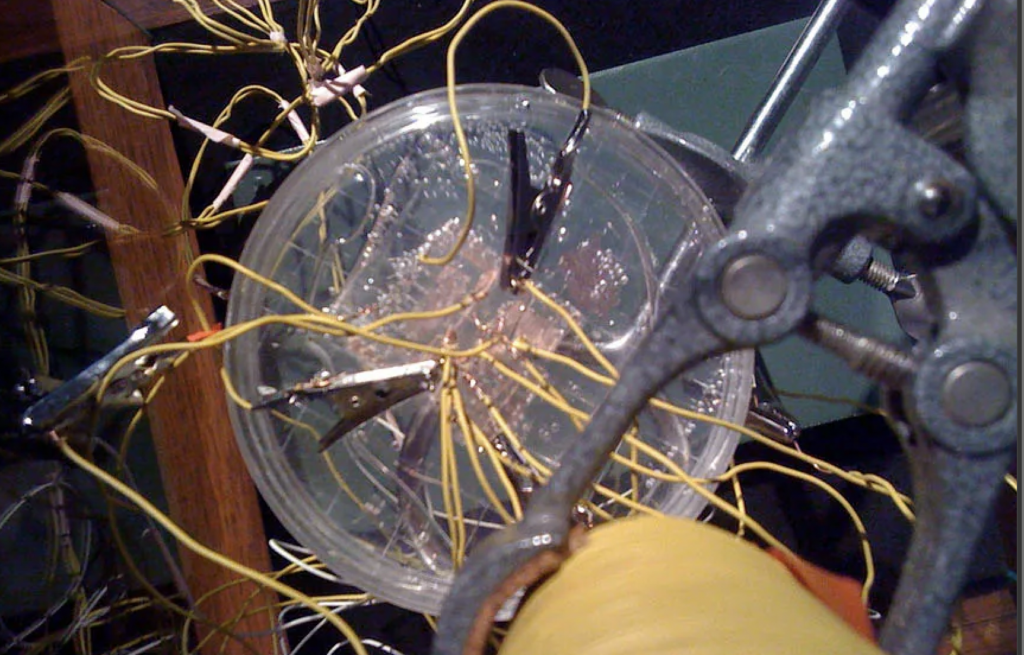 |
| Microvenus, Joe Davis (1986) (Source: CLOT Magazine) |
Joe Davis was a pioneer in BioArt, he formed ideas about how to incorporate genes into an artist's palette to shock both the scientific and artistic worlds (Vesna). Davis' most fascinating art project was the Microvenus in 1986 where he "collaborated with molecular biologist Dana Boyd to insert for the first time a non-biological DNA message into a coding sequence" (CLOT Magazine). Davis encoded a binary representation of the Germanic rune for the female goddess of earth and life in the space-resistant E-coli bacteria and sent it in the hopes of outwardly representing humanity to extraterrestrial life forms. Davis did this in response to the Pioneer 10 and 11 space probes which consisted of nude male and female bodies. Davis was appalled by this representation stating “it’s almost as if they sent a picture of man and Barbie Doll into deep space” (Nadis). The Microvenus icon he sent instead represented not only the ancient Germanic rune of the female body, but also the female genitalia. Davis connected societal issues, such as gender disparities, with his powerful pieces of BioArt that challenged science. Harvard biologist Jay Lee stated that Davis to him is a "scientist ahead of his time, unconstrained by the traditional baggage of science" (Nadis).
 |
| Davis and his colleague, Dana Boyd, synthesized DNA molecules to render an anatomical detail that was not included on the Pioneer plaque. (Source: Joe Davis) |
Eduardo Kac's art piece featuring the genetically modified GFP bunny named Alba serves as a thought-provoking exploration of the intersection between biotechnology and art while raising crucial ethical issues for society to contemplate. By creating a fluorescent green rabbit through the insertion of a fluorescent protein gene, Kac challenges traditional notions of artistic expression and blurs the boundaries between living organisms and artistic mediums (Kac). It forces us to question the potential consequences of our actions in the realm of biotechnology, the ethics of genetically modifying animals for aesthetic purposes, and the commodification of living beings. Kac's art piece on Alba illuminates the need for informed public discourse on the ethical dilemmas arising from the convergence of science, technology, and art, inviting us to critically examine the values and ethical frameworks we uphold in an increasingly complex world.
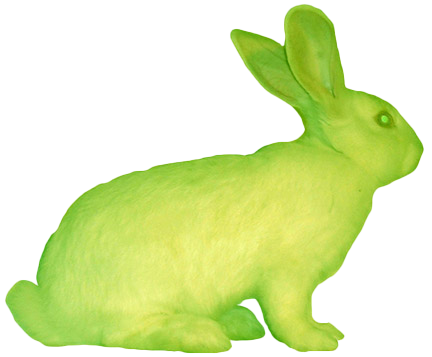 |
| GFP Bunny (Source: Eduardo Kac) |
To conclude this blog, I wanted to focus on why the controversial field of BioArt can provide humanity with context and a deeper understanding of genetic technologies. BioArt plays an important role in "critically challenging emerging life science applications, stimulating of scientific thinking, and contributing to new research questions and new technologies" (Yetisen). BioArt pieces often confront issues such as genetic engineering, biotechnology, cloning, and synthetic biology, presenting them in a tangible and visually engaging way. Despite the ethical debates surrounding the formation of BioArt, I strongly believe that the awareness it brings to society makes it one of the most critical forms of art in the world.
References:
Kac, Eduardo. "GFP bunny." Leonardo 36.2 (2003): 97-102.
Levy, Ellen K. Defining Life: Artists Challenge Conventional Classification. 2022.
Nadis, Steve. “Creating Art from Microbes and Molecules.” Discover Magazine, 12 Nov. 2019, www.discovermagazine.com/the-sciences/creating-art-from-microbes-and-molecules.
Vesna, Victoria. “Lecture Part 1” BioTech+Art | Lectures. https://bruinlearn.ucla.edu/courses/129896/pages/unit-6-view?module_item_id=4852527.
Yetisen, Ali K., et al. "Bioart." Trends in biotechnology 33.12 (2015): 724-734.
“Joe Davis, from Microvenus to Astrobiology.” CLOT Magazine, 29 Sept. 2017, clotmag.com/biomedia/joe-davis.
Image Citations:
1. “Microvenus, Joe Davis (1986).” CLOT Magazine, https://clotmag.com/biomedia/joe-davis.
2. Davis, Joe. "Microvenus." Art Journal 55.1 (1996): 70-74.
3. Kac, Eduardo. "GFP bunny." Leonardo 36.2 (2003): 97-102.

Hey Utkarsh! I really enjoyed your discussion on the Microvenus and how its creator was known as a scientist ahead of their time. By combining art with science, they were able to reach new fields that would have otherwise been inaccessible. I also liked your discussion of the GFP, and your acknowledgement that although it demonstrates a fascinating aspect of biotech and art, that there are many ethical issues that come into play, especially when live animals are in question. I agree with your last point that BioArt indeed brings awareness to the world, which remains an important principle in the advancement of society. Keep up the great work!
ReplyDeleteI really liked your blog post. I hadn't heard of Microvenus before, but I very much enjoyed learning about it from you. I think it was really good of you to include both the ethical debate on bioart and what good it can do. I think it is important to include that modifying nature in a way that bioart does is in fact rather unnatural and shows a desire to dominate nature and other organisms, as it shows that the intent behind the art is an important factor when judging the ethics of specific projects.
ReplyDeleteHi Utkarsh, I really enjoyed reading your post and think it gave great insight into bioart by focusing specifically on Joe Davis and his contributions to the field. I appreciate that you took time to explain more in-depth into microvenus and what it stands for. I also agree that bioart helps society by bringing forth ethical dilemma that wouldn't be talked about if not for the publicity gained by these scientists and artists. Thank you for your post!
ReplyDelete