The intersectionality of the field of mathematics and art is something that I have been exposed to throughout my education especially due to my schooling which required interdisciplinary projects. There are some key insights, nonetheless, that I gained through this week's materials. In the lecture video, Dr. Vesna goes into detail about Brunelleschi, a 13th-century artist who pioneered the linear perspective and discovered that there should be a "single vanishing point to which parallel lines in a plane converge." The combination of optics and mathematics created art that was more realistic, and fascinating and led to methods that are still utilized in modern works of art.
Flash-forward to the 21st century, with the invention of computers and better processors, I found the works of Charles Csuri to be incredibly fascinating. Csuri is recognized as a pioneer of computer art and animation and "his research and artistic vision led to advances in software that created new artistic tools for 3D computer graphics, computer animation, gaming, and 3d printing" (Charles Csuri, Bio). Csuri's work strongly highlights how art, math, and technology can intersect to further technological developments and, as Csuri describes it, "create art by a computer that’s humanly impossible by conventional artistic methods."
Source: “Art 2011-2022.” Charles Csuri, www.charlescsuri.com/current.
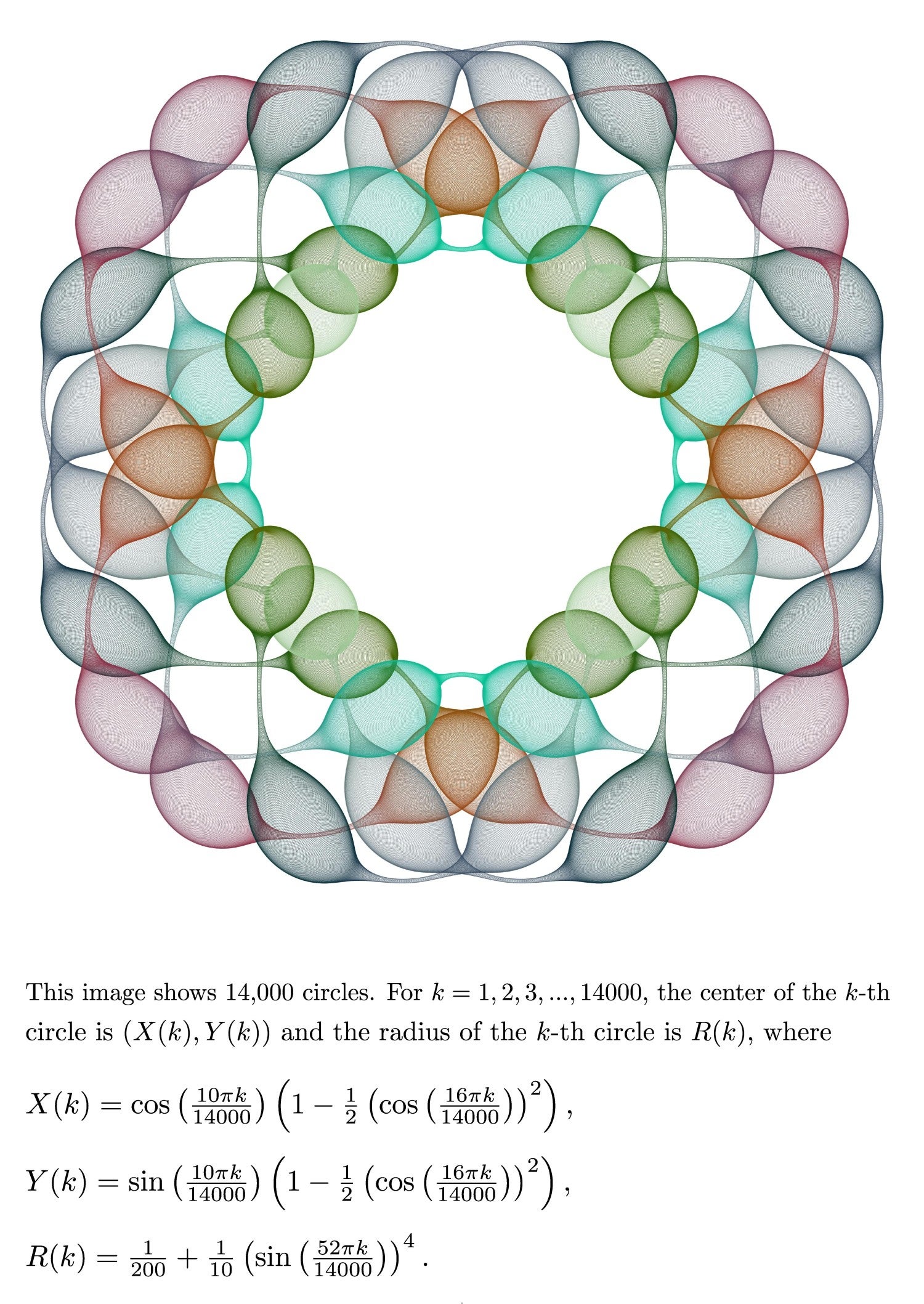
Creating mathematical art has enabled not only the creation of incredible, non-conventional works of art, but the visualization methods to help understand mathematics itself and draw incredible insights. As Yeganeh states in his article, "art and mathematics are not just related, but rather they are inseparable parts of a unified whole that help us to better understand the beauty and complexity of our world" (Making Mathematical Art).
Source: 14,000 Circles by Hamid Naderi Yeganeh
These works of art that use mathematics at their core show how artists are able to use not only artistic creativity in its traditional sense but also mathematical creativity that leads to new developments in the fields of mathematics, science, and the arts. The juxtaposition between mathematics, art, and science is evident throughout different theories and concepts and an example I have encountered from my own educational experience is that of the Fourier Series. The video below by 3Blue1Brown is a fascinating illustration of how artistic visualization can help explain complex mathematical and scientific concepts that lie at the core of modern technologies.
Source: But what is a Fourier series? From heat flow to drawing with circles | DE4 by 3Blue1Brown
Reflecting on this week's material, I have learned that art and mathematics go hand in hand. What we perceive as creative revolutions in the arts are often brought about due to breakthroughs in technology and vice versa. The intersectionality of these fields demonstrates just how influential each field is in its respective sense and why they should not just be viewed as "Two Cultures" but rather as connected unified realms.
References:
Sims, Karl. “Understanding Julia and Mandelbrot Sets.” Karl Sims, www.karlsims.com/julia.html.
Hi Utkarsh! I think you did an amazing job explaining the intersectionality between mathematics and art and how they are not as separate as first perceived. I enjoyed your discussion of historical figures and how their works further contributed to the discussion of the 2 disciplines. I also appreciate your insight on the topics as well. Stemming from your background of interdisciplinary projects, I felt your personal contributions to the blog were invaluable and added another layer of detail. The video you included also does a great job summarizing this week's topics. Keep up the great work!
Hi! I really enjoyed reading about how you related your personal thoughts on this subject and your interests in computer sciences. As well as talking about both the past and present. When doing this blog I never really thought about how we can use computers and mathematics to make art via graphs, lines, etc. It was nice to read about a different perspective and how you mathematicians are also artists.
Hey Utkarsha! I really enjoyed reading your blog! I liked your personal thoughts and ideas related to the topic of the week. It was also nice to hear that you have been exposed to the concept of math and art being connected throughout your education experience. That is something I can relate to as well. Overall good job in your post!
Hey Utkarsh, I really enjoyed reading your blog entry! I thought you characterized how our education and exposure to different fields can help us draw these important connections between art and mathematics. I especially liked your example about how not only advances in art can help with mathematics but how science is also another field where art can help us conceptualize concepts (such as the Fourier Series). Great read overall!
Hi Utkarsh, I enjoyed reading your post especially in regard to the introduction of 3Blue1Brown's Fourier series video. The cover of that video is a clear indication of using mathematical techniques to create artsy visual representation of a portrait. I personally have loved watching 3Blue1Brown's videos because the channel combine hard, abstract math concepts with geographic visualizations. The lectures to me, is a well curated museum of art pieces.
Hi Utkarsh, I really appreciate how you incorporate the concept of intersectionality in your blog, as I believe it offers a clear illustration of the concept of juxtaposition. I am able to understand how the convergence of parallel lines in a plane towards a single vanishing point, as well as how the optics and mathematics created art. However, upon viewing the 3Blue1Brown videos featured in your blog, I remain astounded by the potential of the Complex Fourier series to facilitate the mathematical rendering of any desired shape by manipulating the size and angle of each vector.



Hi Utkarsh! I think you did an amazing job explaining the intersectionality between mathematics and art and how they are not as separate as first perceived. I enjoyed your discussion of historical figures and how their works further contributed to the discussion of the 2 disciplines. I also appreciate your insight on the topics as well. Stemming from your background of interdisciplinary projects, I felt your personal contributions to the blog were invaluable and added another layer of detail. The video you included also does a great job summarizing this week's topics. Keep up the great work!
ReplyDeleteHi! I really enjoyed reading about how you related your personal thoughts on this subject and your interests in computer sciences. As well as talking about both the past and present. When doing this blog I never really thought about how we can use computers and mathematics to make art via graphs, lines, etc. It was nice to read about a different perspective and how you mathematicians are also artists.
ReplyDeleteHey Utkarsha! I really enjoyed reading your blog! I liked your personal thoughts and ideas related to the topic of the week. It was also nice to hear that you have been exposed to the concept of math and art being connected throughout your education experience. That is something I can relate to as well. Overall good job in your post!
ReplyDeleteHey Utkarsh, I really enjoyed reading your blog entry! I thought you characterized how our education and exposure to different fields can help us draw these important connections between art and mathematics. I especially liked your example about how not only advances in art can help with mathematics but how science is also another field where art can help us conceptualize concepts (such as the Fourier Series). Great read overall!
ReplyDeleteHi Utkarsh, I enjoyed reading your post especially in regard to the introduction of 3Blue1Brown's Fourier series video. The cover of that video is a clear indication of using mathematical techniques to create artsy visual representation of a portrait. I personally have loved watching 3Blue1Brown's videos because the channel combine hard, abstract math concepts with geographic visualizations. The lectures to me, is a well curated museum of art pieces.
ReplyDeleteHi Utkarsh, I really appreciate how you incorporate the concept of intersectionality in your blog, as I believe it offers a clear illustration of the concept of juxtaposition. I am able to understand how the convergence of parallel lines in a plane towards a single vanishing point, as well as how the optics and mathematics created art. However, upon viewing the 3Blue1Brown videos featured in your blog, I remain astounded by the potential of the Complex Fourier series to facilitate the mathematical rendering of any desired shape by manipulating the size and angle of each vector.
ReplyDelete